
By Steuart Pennington
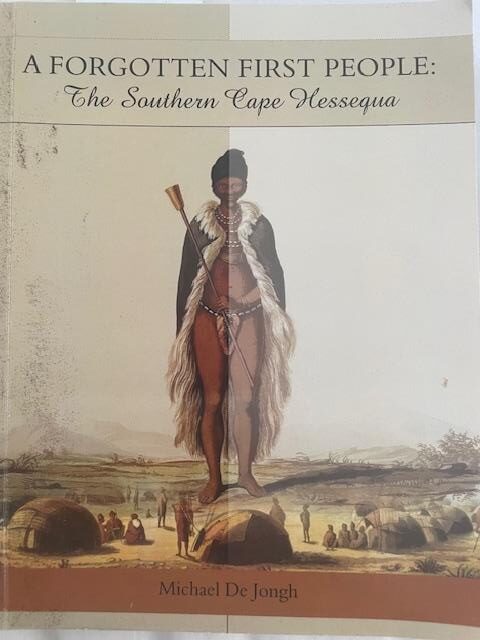
Michael de Jongh’s “A Forgotten First People” will provide many answers to anyone who has an interest in the land question in South Africa, particularly because the debate rages around the ANC’s intentions in respect of Expropriation without Compensation (EWC)
Reading this book prompted me consider the current status quo.
Four critical realities that emerge
Reality 1. Some 2000 years ago, the Khoekhoe community, pastoralists, some anthropologist think of Arabian descent, arrived at the tip of Southern Africa. Pejoratively they are often referred to as Hottentots. Their large settlements were encountered along our western and eastern coasts and documented by early explorers Bartholomew Dias and Vasco da Gama. The Bushman (a preferred term) mostly hunters and gatherers, also inhabited Southern Africa some 2000 years ago, as documented Bushman paintings exist throughout the Drakensberg, the Karoo and the Western and Eastern Cape.
Reality 2. When the Europeans arrived in 1652 (not the first European to step ashore, but the first to build a settlement), these were the peoples they encountered (evidence of Homo Sapiens in various forms had obviously existed previously – Cradle of Mankind etc). Jan van Riebeeck’s party consisted of 82 men and 6 women, they almost immediately began to barter cattle and sheep with the local Khoekhoe people. Overtime, two or three hundred years, a degree of inter-marriage took place, but both the Khoekhoe and the Bushmen populations were ravaged by three epidemics of Smallpox. Sure, there was occasional conflict, but this was not the main reason for population decline.
Reality 3. As the Trekboers moved East they came into contact with the isiXhosa in the late 1700’s in the Fish river area, and as they moved north they encountered off-shoots of the Khoekhoe community eg, the Griqua. In my review of the history of the Eastern Cape https://www.sagoodnews.co.za/writing-the-ancestral-river-a-biography-of-the-kowie-jacklyn-cock/ it is well documented that much of the isiXhosa language has its origins with these early peoples. It is also well documented that the isiZulu set about the extermination of the Bushman in the larger Drakensberg region, there is a little evidence of Nguni peoples being south of the Fish River before 1700.
Reality 4. The 1913 Land Act came way after the demise of these early peoples and was designed primarily to prevent competition from an emerging Black farming class as well as to create reserves of cheap uneducated labour in designated ‘homelands’ by entrenching a dual-economy, much in evidence to this day, and pertinently, post 1994, allowed to remain as ‘extractive’ institutions governed by a ‘king’ with no private land ownership permitted.
Four critical facts:
Fact 1: The South African government currently owns a significant portion of the country’s land, with estimates from various reports placing state ownership around 21% to 23%, totalling roughly 28 million hectares. The former homelands in South Africa comprise approximately 13% to 14% of the country’s total land area, roughly 16.4 to 18 million hectares of land. About 3% is privately owned urban sprawl.
Fact 2. There are an estimated 40,000 to 44,000 white commercial farming units in South Africa, who collectively own approximately 61 million hectares of freehold agricultural land, representing around 50% of the country’s total surface area, and employing approx. 1 million people.
Fact 3. With 30 years of Land Restitution (the process of restoring ‘stolen’ land) and as of 2024/early 2025, over 83,200 land restitution claims have been settled by the Commission on Restitution of Land Rights (CRLR) since its inception in 1995 (mostly in cash), with a remaining backlog of approximately 6,139 “old order” claims (lodged before the 1998 cutoff date).
Fact 4. With 30 years of Land Redistribution (Purchasing ‘white’ farm land to give to new ‘black’ owners (LRAD) programs have transferred millions of hectares since 1994, with figures varying, but around 7.55 million hectares purchased for redistribution and another 6.68 million hectares restored via restitution, with recent reports citing over R6bn spent between 2019-2023 for both, and earlier figures showing R50bn spent by 2018 for about 4% of land (around 4.4 million hectares). Costs per hectare have been lower than market rates, but significant funds have been allocated, with ongoing efforts and varying success in supporting beneficiaries – with a 75% ‘commercial success’ failure rate (Govt. record)
Conclusion
What “A Forgotten First People’ did for me was to situate thoughts on the history of South Africa and it’s early peoples, and in particular the land ‘ownership’ debate. It suggests that they were two waves of land theft, the first in the North of the Bushmen by the Nguni peoples, the second of the Khoekhoe in the South by the Europeans. It is unthinkable for ANC politicians to argue that ALL land was ‘simply’ stolen by ‘whites’ from ‘blacks’ when there is undeniable proof that both were guilty of stealing land from ‘Our Forgotten First People’.
Presently, current stats suggest the government and previous homelands are in possession of just under 40% of the land and substantial progress in respect of returning land has been made through the restitution and redistribution processes, maybe around 13%. Sure, white farmers own 50%, and urbanisation accounts for 3%, but as the Institute of Race Relations points out, orderly land reform, supported by the majority of South Africans is felt infinitely preferable to the invasion of property ownership rights via ANC promoted EWC – ala Zimbabwe.
There must be more creative ways to settle this debate by first understanding the history of land ownership in South Africa and second by looking to what our best interests are in respect of productive land use and sustainable food security.
Such a fascinating read.
ISBN 978-0-620-69319-6
Published in 2016
Published by The Watermark Press
Printed by BkBookbinders Durban
The post AN ESSENTIAL CONTRIBUTION to the LAND QUESTION in SA appeared first on The Home Of Great South African News.
By Steuart Pennington Michael de Jongh’s “A Forgotten First People” will provide many answers to anyone who has an interest in the land question in South Africa, particularly because the debate rages around the ANC’s intentions in respect of Expropriation without Compensation (EWC) Reading this book prompted me consider the current status quo.
The post AN ESSENTIAL CONTRIBUTION to the LAND QUESTION in SA appeared first on The Home Of Great South African News. Read More