England talk themselves into a fight and the Springboks finish it, writes MARK KEOHANE.
England always arrive in South Africa believing they have solved the Springbok puzzle. And South Africa always respond with the same brutal reminder. The tight five do the beating; and the back three finish it off.
It was true in 1984. It was true in 2007. It was true in 2012. It was true in 2018.
It was true in Japan in 2019 when the Springboks physically dismantled England in the World Cup final and then watched right wing Cheslin Kolbe streak away into history.
And it feels true again in 2026.
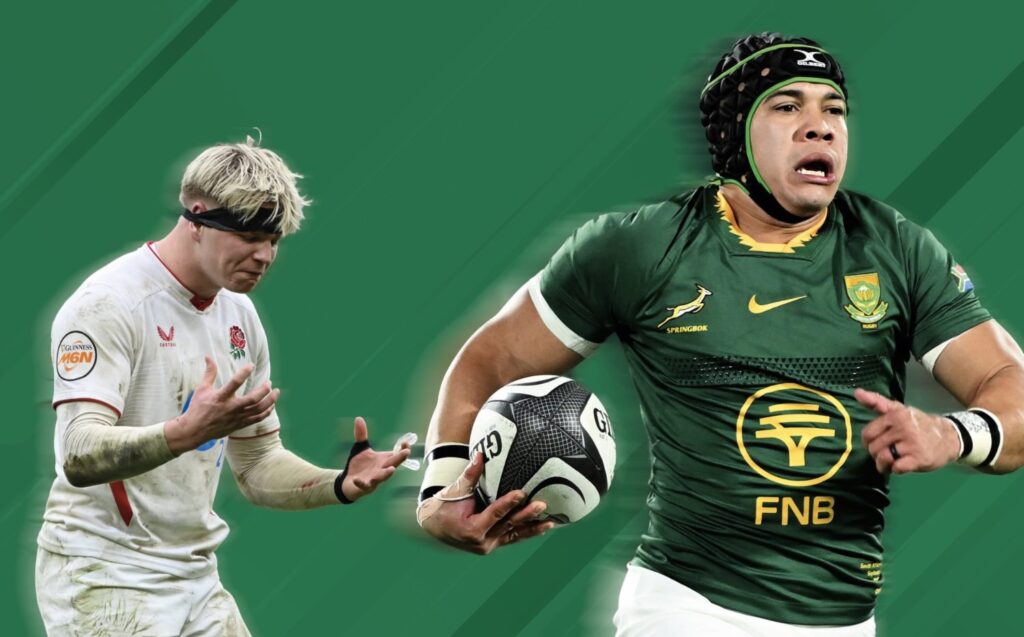
SA Rugby magazine’s cover said it all: a frustrated Henry Pollock and another green-and-gold blur disappearing into space. It is Kolbe in full flight and England in retreat as the Twickenham noise is drowned out by South African certainty, whether on the field or in the stands at Ellis Park.

The reality of England in South Africa is that the jerseys may be tweaked for fashion, player hairstyles may change, eras may bring different distractions and the weather may be inconsistent, but what remains consistent is that England talk themselves into a fight and the Springboks finish it.
The Springboks are the most complete side in world rugby. Since winning the 2023 World Cup in Paris, they have backed it up with consecutive Rugby Championship titles, including three wins in four against the All Blacks, unbeaten 2024 and 2025 end-of-year tours in the northern hemisphere and victories over every major nation, home and away.
Their win percentage under Rassie Erasmus remains above 80% in the past two seasons and, despite using close to 60 players, their identity remains untouched.
The Springboks, under Erasmus, know exactly who they are, and this is the biggest difference between the two sides heading into Johannesburg for the 4th of July fireworks at Ellis Park.
That and the three World Cup golds that separate South Africa’s four and England’s one title win in Australia in 2003.
No team wins as little as England and gets celebrated as much. No team gets as hyped as England, and no team matches England for turning a second-place finish into a glorious lap of honour.
The Springboks, with four World Cup golds and two bronze medals in eight tournaments, have never enjoyed the luxury of England’s hype or the forgiveness and forgetfulness of winning one World Cup title in 10 attempts, as is England’s record.
Before the 2026 Six Nations, England’s players and the English media could not stop talking about the Springboks. Steve Borthwick’s side arrived in the championship unbeaten in 11 Test matches, including a 33-19 win against the All Blacks at Twickenham.
This result was echoed as confirmation of their arrival at the top table of Test rugby. The All Blacks’ vulnerability, having been crushed 43-10 by Erasmus’ Springboks in Wellington, was conveniently forgotten in the celebration of the rare England win against the New Zealanders.
Right now, the All Blacks are not the barometer of self for rugby’s nations. The measurement is Erasmus’ Springboks and since the 2019 World Cup title win, more questions are asked when the Boks lose a Test than statements are made when they beat the All Blacks.
England’s players don’t learn from history; the 2019 humiliation is particularly damning of their arrogance and ignorance. They beat up the All Blacks in the semi-final, celebrated already winning the World Cup, and got beaten up by the Springboks in the final.
The players were an embarrassment talking themselves up in the buildup to the final and an even bigger one for raising the white flag in the final quarter of the Boks’ 32-12 win.
Fast forward to the 2026 Six Nations and the on-field and off-field embarrassment was as obvious as that last week of the 2019 World Cup.
England’s players arrived on a chariot and were carried out on a stretcher. And for the odd one still walking, they limped out of the Six Nations having cartwheeled into it.
They believed they had arrived because of that one All Blacks result, but what followed was a sorry night against Scotland, a hammering against Ireland at home, and a first-ever defeat to Italy.
France, in the final match, offered a chance to be bold, given there was no pressure on England. They responded as one would expect for a Barbarians-type exhibition, but they self-destructed in the final minute when the match demanded a Test-type mentality to finish off France.
The unbeaten run vanished under pressure because England remain a side searching for an identity. They want to play with width but don’t fully trust it. They want to dominate collisions but don’t possess South Africa’s depth among the forwards. They want to play fast but panic when dragged into trench warfare.
They want to be what the Springboks are right now: a team with such unshakeable belief, understanding of its strengths and vulnerabilities and critically aware that its public remembers the Tests they lose and not always the 80% they win.
Erasmus has built a squad with frightening clarity. Every player understands the role.
Every forward understands the violence required in those collisions and at the scrum engage, and every back appreciates that defence is as beautiful as Kolbe’s step on attack.
The numbers since the 2023 World Cup title win reinforce everything about the Springboks, who have learned that expectation is a compliment and not a burden.
The Boks went to Dublin and systematically dismantled Ireland. They went to Paris and ran away from France. They outplayed Italy in Turin and humiliated Wales 73-0 in Cardiff. That last scoreline mattered because it showed the ruthlessness of these Boks.
England know exactly what is coming in Johannesburg, and history says it rarely ends well for them in South Africa.
England’s overall Test record in South Africa is poor across both the amateur and professional eras. Since their first tour in 1891, England have traditionally struggled against the Springboks on South African soil. The professional era has been especially unforgiving. Since 1996, England have won only a handful of Tests in South Africa while regularly being overwhelmed physically in Johannesburg, Pretoria and Cape Town.
The history between these nations is deeper than rugby. For South Africans, England have always represented more than another opponent. The relationship is soaked in political history, colonial scars and generations of cultural tension. References to the Boer War still surface at braais and in rugby conversations.
English touring teams have long been treated as sporting villains in South African rugby culture. That hostility intensifies when England arrive with swagger. And England always arrive with swagger.
SIR CLIVE: England can ‘deliver a result’ against Boks
Springbok victories over England feel different in South Africa because they are more personal. Equally, they are more satisfying, and no opponent is celebrated more loudly when beaten.
Yet alongside the hostility sits respect from the Springbok players and coaches for when England do get it right.
They know England can produce packs capable of surviving brutality and that the English bulldog spirit does enjoy trench warfare.
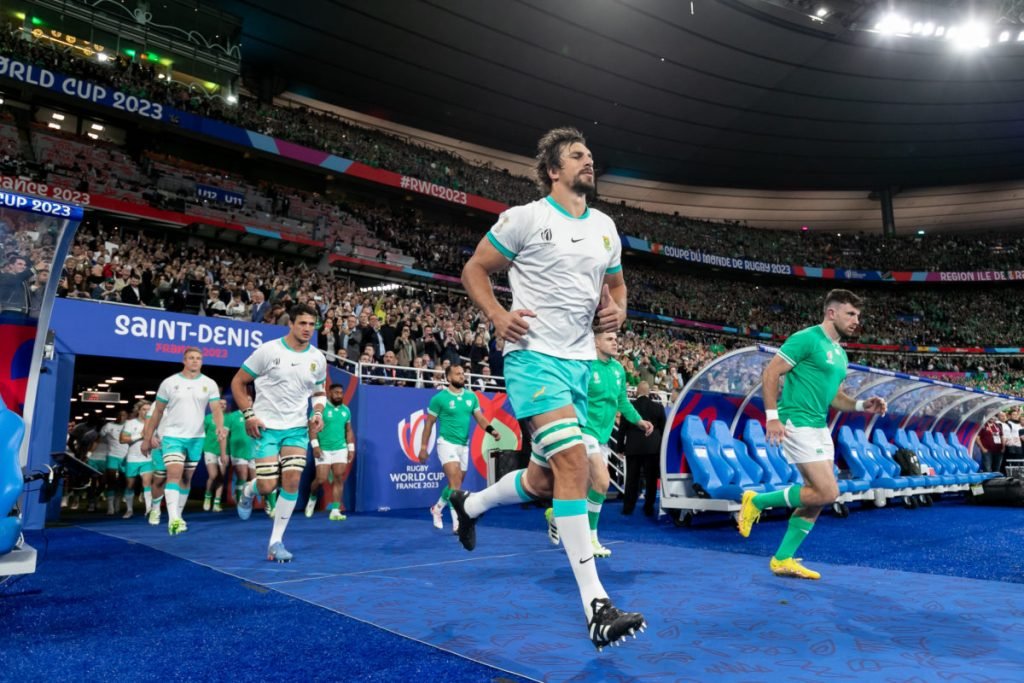
England showed this when a 50m Handré Pollard penalty kick, nailed in the 79th minute, denied them the most famous of wins in Paris in 2023. That respect is precisely why Bok victories over England resonate so powerfully.
That 2023 World Cup semi-final defeat damaged the psyche of England’s players because they believed they had the Boks beaten, and their elaborate on-field celebrations proved premature, as they did at the very same venue in Paris against France in March.
England’s mentality is fragile and South Africa’s is frighteningly strong.
ALSO: Kiwi to ref Boks vs England at Ellis Park
Borthwick remains England coach through to the 2027 World Cup regardless of results, but the identity remains blurred. England alternate between kicking conservatively and trying to play expansively. Selection changes continue and their systems shift.
There is no obvious pattern to what is going to arrive in South Africa in the guise of England.
The Springboks have no such instability. Erasmus has spent years building two world-class packs, with multiple tactical identities and extraordinary depth. He rotates match 23s without weakening the performances.
SQUAD: Pollock to face Boks, Itoje rested
England will arrive talking about ambition and redemption and Pollock will be paraded as a prized pony, if not by the team management then by his off-field promoter Eddie Hearn and his management.
English pundits will revisit Paris and convince themselves the gap is small. But the Springboks have heard this before, and they know exactly how to break it.
It always starts with a scrum and ends with a bashing.
– This article first appeared in the July 2026 issue of SA Rugby magazine. The August 2026 issue is also available to read for FREE.

The post Poms set for Bok bruising at Ellis Park appeared first on SA Rugby magazine.
England talk themselves into a fight and the Springboks finish it, writes MARK KEOHANE.
The post Poms set for Bok bruising at Ellis Park appeared first on SA Rugby magazine. Read More