For more than a century, no fixture has tested, inspired and defined the Springboks quite like the All Blacks, writes MARK KEOHANE in SA Rugby magazine.
I have spent most of my adult life writing about the Springboks. I have watched them win World Cups, lose the unthinkable, rebuild, implode, rise again and, more than once, make a nation feel 10-feet tall.
But there is still only one fixture that trumps everything, and it is the All Blacks.
It is the one that sets the standard and tells the story of the Springboks’ strength, alternatively their vulnerability.
There is something so special about South African green and gold lining up opposite New Zealand black and white.
Everything else matters.
England matter. France matter. Ireland matter. Australia will always matter. The British & Irish Lions matter because of the rarity and romance of the tours to South Africa every 12 years. But none of them define South African rugby the way New Zealand do.
And, whether they say it loudly or quietly, the All Blacks know the same about the Springboks.
This is not just another tour, nor is it an ordinary rugby series. The All Blacks coming to South Africa is rugby returning to its most demanding classroom. The Springboks against the All Blacks is a match-up that does not require marketing slogans or manufactured hype. The history between these two teams sells the next match.
It is rugby’s greatest rivalry because it has always been about the greatest standard.
For the Springboks, the All Blacks have never simply been an opponent. New Zealand have been the mirror and the challenge and the feel-good factor for Bok supporters. They are the one result South Africans want and, particularly in the last decade, it is the one result the All Blacks want in their favour.
For New Zealand, South Africa has been the one country that never looked at the All Blacks with fear. There has always been respect and admiration, but never fear, which is why in the history of the game the All Blacks’ only Test series win came in 1996.
The rivalry is based on absolute reverence and an appreciation of the qualities of both rugby nations. What is beautiful about the contest is that the anticipation and trepidation are built on passion and not any form of hatred.
The passion comes not from hyped marketing speak but from the collisions, the scrum, the aerial contest, the tackles and the linebreaks. It comes from those incredible clutch penalty and conversion kicks to win the Test match.
The Springboks and All Blacks have never needed to invent an edge because the edge is in the history and in the familiarity of the jersey. The Boks play in green and gold and the All Blacks play in black and white.
It has always been that way. These two teams don’t sacrifice tradition for a fashionable colour coding. Hopefully, they never will.
I have never bought the lazy line that South Africa against New Zealand is just brawn against skill. That is too easy and too ignorant. The best Springbok teams have always had skill. The best All Blacks teams have always had brutality.
What has made this contest so enduring is that each country has carried a different rugby truth and, over time, each has had to learn from the other.
South Africa gave rugby a language of confrontation that worshipped at the altar of a set-piece, pressure, defence and territory. It is about physical dominance. It really is that simple.
Nothing has changed since the two nations first ran at each other. It starts and finishes by who owns the collisions.
New Zealand gave rugby a language of possibility and romantic indulgence of why the sport is described as the game they play in heaven. They have always preached and practised continuity, handling, counter-attack, support lines and a refusal to believe a ball is dead until the whistle says so.
Every great team in the modern era has borrowed from both the Springboks and All Blacks, and these two have borrowed from each other.
Richie McCaw’s 2011 and 2015 back-to-back World Cup winners set the standard that most thought could never be matched for dominance, relevance and reward. Siya Kolisi’s 2019 and 2023 back-to-back World Cup winners share that podium. Nothing separates them in achievement or awe.
The Springboks of today are not just maul, scrum and muscle. They are variation, tactical intelligence, kicking pressure, bench impact, chaos management and moments of breathtaking ambition. The All Blacks of today are not just flair, width and instinct. They are set-piece focus, defensive steel and the understanding that pretty rugby without confrontation is just decoration.
The two nations continue to lift each other and in those cycles where one has failed in competitiveness, there has been an acknowledgement from supporters on both sides that any dominance is short-lived.
The best rivalries force each other to evolve and few would dispute that South Africa have made New Zealand harder and New Zealand have made South Africa smarter. Together they have dominated the world order, winning seven of the 10 World Cup tournaments and boasting the top two win percentages in Test history.
Every Springbok generation gets judged by New Zealand and right now it will be true for the All Blacks, as it was for every generation outside of that which played during South Africa’s international sporting isolation.
You can beat England and feel powerful. You can beat France and feel stylish. You can beat Ireland and feel current. You can beat Australia and feel satisfied. But there is something so different about beating the All Blacks.
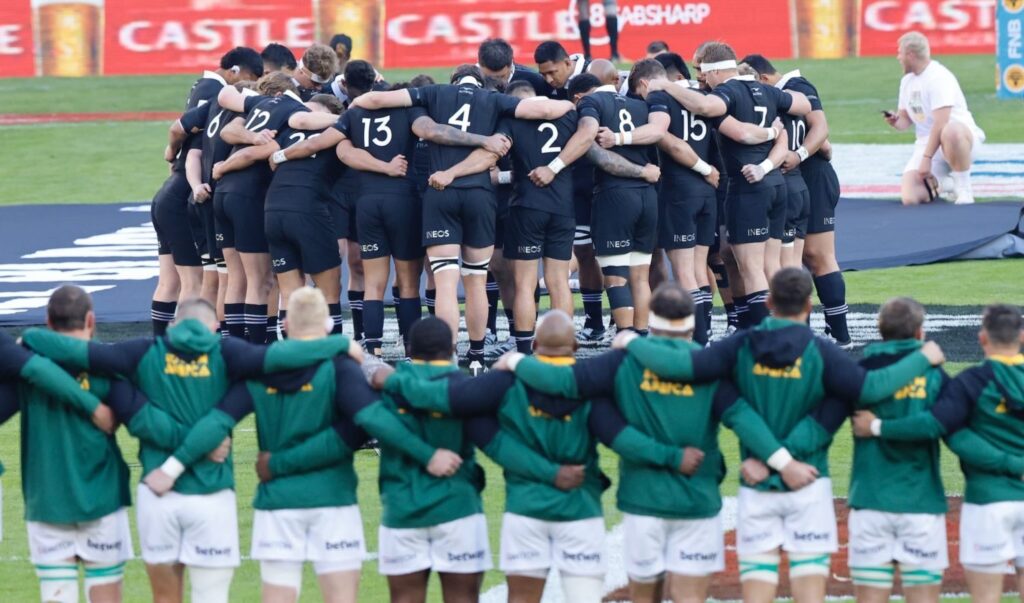
There is a mystique about the black and white jersey for South Africans and there is a seduction to the haka and pre-match ritual when the All Blacks lay down the challenge to the Springboks.
Having spoken to so many different All Blacks since their international return to South Africa in 1992, the overriding sentiment has been that touring South Africa is so different because the players arrive in South Africa with a status as big as the South African supporters see in the Springboks.
There is also so much support for the All Blacks in South Africa. The Boks are celebrated and revered in South Africa and the same is true of the All Blacks. The Kiwis are as big a personality to the South African rugby public as the Springboks.
I was privileged to report on the 1996 All Blacks tour of South Africa and a sporting nation lived the All Blacks being in the country for two months. What will change in August and September is that even more of the population will live, breathe and enjoy the first All Blacks tour of South Africa in 30 years.
South Africa’s exit from Super Rugby has meant many of the current All Blacks have had limited exposure to South Africa, in the guise of one-off Rugby Championship Tests.
Now this New Zealand generation of players will get to understand and appreciate the love of the game in this country and the admiration and respect there is for the All Blacks jersey and those many fantastic New Zealand players who have played in South Africa.
Ellis Park, filled to capacity, Cape Town Stadium and the 94,000 FNB Stadium in Soweto are the theatres in which the three Tests will be played, but the tour will also take the All Blacks to Pretoria and Durban for matches against the Bulls and Sharks.
The Ellis Park and Cape Town Stadium experience will be doubled because of matches against the Lions and Stormers.
From a South African rugby perspective, the Rugby’s Greatest Rivalry tour is bigger than the British & Irish Lions tour, which indicates the magnitude of this visit from New Zealand.
This is going to be a rugby pilgrimage for the New Zealanders, with the final Test in four to be played at a neutral venue in Baltimore, USA.
Economics has determined this finale to the tour, but for the most part, tradition has triumphed in a schedule that sees seven of the eight tour matches played in South Africa.
The All Blacks play three tour matches before the first Test at Ellis Park on 22 August, which allows for momentum, for storytelling and for a narrative.
It is a tour that will educate the South African rugby public as much as it does entertain, and the one advantage of touring, more than hosting, is that a match 23 can get built in a month and not be predetermined because of a one-week turnaround between Test matches.
There are so many wonderful players who will make the tour and they will front South Africa’s golden generation, led by Kolisi and the coaching mastermind Rassie Erasmus.
The contrast in styles will make each Test riveting. Already the most asked questions include whether New Zealand can handle South Africa’s aerial kicking game and physicality and whether South Africa can match or negate the tempo at which New Zealand will play.
The Springboks and All Blacks are ranked one and two in the world and the Boks won the 2023 World Cup final 12-11 against the All Blacks in Paris.
If you get asked to summarise Rugby’s Greatest Rivalry, that one-point differential in Paris nails it. The All Blacks were a missed penalty kick away from winning the final and the Boks’ scrum held firm on the final play to win the final.
There was blood and so much thunder when these two teams played for world rugby’s greatest prize in Paris in 2023, but that one-off was a curtain-raiser to them going at each other for three Tests in South Africa and one in the USA to determine a generational legacy.
This series is going to be brutal and, for the rugby purist, so beautiful.
FREE DIGI-MAG: All Blacks tour special

Photo: Kim Ludbrook/EPA
The post Springboks vs All Blacks: Why it matters appeared first on SA Rugby magazine.
For more than a century, no fixture has tested, inspired and defined the Springboks quite like the All Blacks, writes @mark_keohane
The post Springboks vs All Blacks: Why it matters appeared first on SA Rugby magazine. Read More