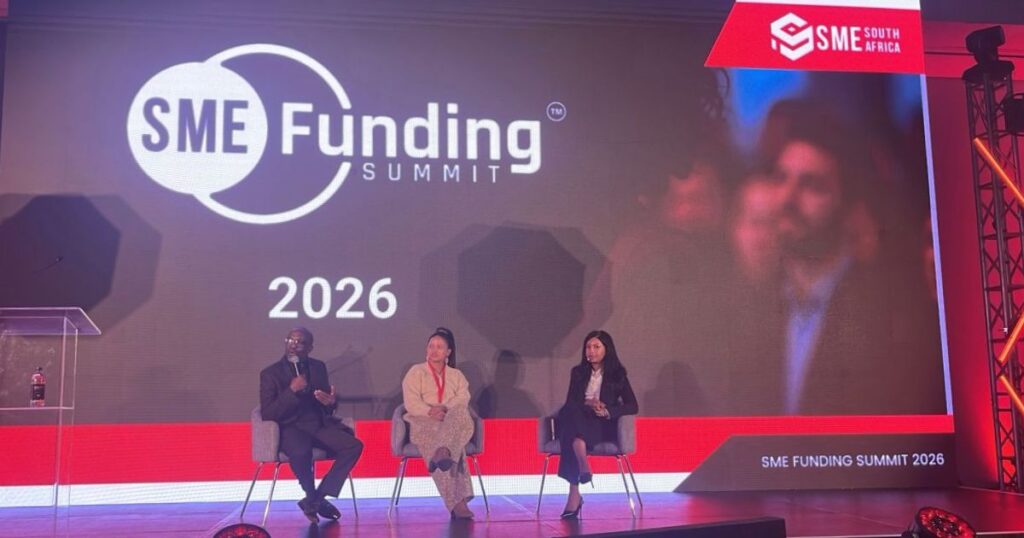
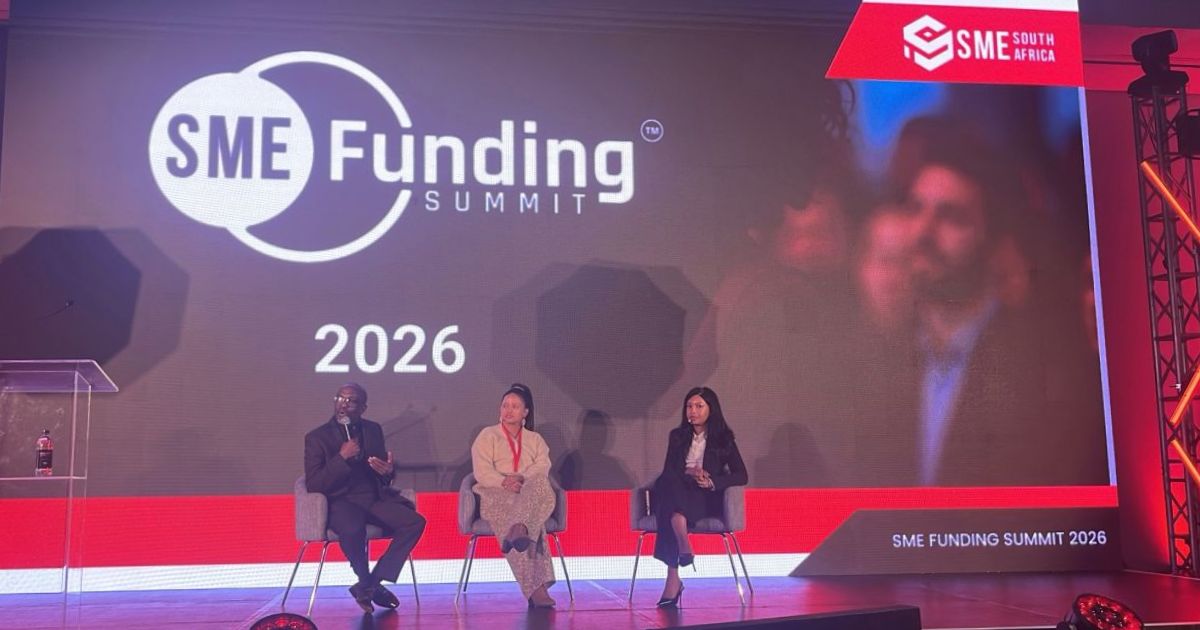
At the SME South Africa Funding Summit, one of the liveliest exchanges came during a panel Q&A session that featured Naledi Gule CA(SA), Associate Partner at Kholo Capital, who fielded audience questions on topics from lender risk appetite to what it really means for a business to be “distressed.”
In light of the trend around educating businesses to seek the right type of funding, her answers align with this philosophy. Access to funding isn’t just about the size of the cheque; it’s about matching businesses with the right type of capital for where they are.
Who Funds the Funders
The first question put to Gule was one that addressed what seems to be a gap between lender expectation and the current economic reality that South African businesses face.
An audience member pointed out that South African capital tends to be considerably more risk-averse than capital from overseas limited partners (LPs) and asked how entrepreneurs can navigate this environment. So why not simply look abroad for funding partners more open to risk?
“As a funder, we also have our own funders, and we’re beholden to them. They have an investment mandate that we have to follow, in a sense,” she says.
Kholo Capital’s Mandate
That mandate currently keeps Kholo Capital’s focus on medium-sized enterprises rather than early-stage startups, but Gule was careful to note that this doesn’t mean the door is closed to smaller businesses altogether. She pointed to a recent investment in a mining contractor as an example of how capital can flow indirectly: “Even though we won’t invest directly in a smaller business, what we do is invest through our portfolio companies. As we build our portfolio, those companies create opportunities to invest in startups and in businesses that don’t necessarily meet our mandate but do meet theirs.”
Her message to founders in the room was that a mismatch with Kholo’s direct mandate doesn’t mean the conversation ends there. “Even if you came to me with a business that doesn’t fit our mandate, we’d still take a look,” she said, “because as our portfolio companies grow, they in turn invest in other entities.”
On the question of overseas capital specifically, Gule was candid about both where Kholo Capital stands today and the practical constraints of looking abroad. The fund’s capital base currently comes from 16 local investors backing a R1,4 billion fund.
The hesitation is about currency risk. “We’d have to return cash flow in that foreign currency while investing locally, so the returns don’t always line up,” she said. Still, she left the door open for the future: “That’s something we’re actively looking into. Since this is our first fund, we’ve focused mainly on the South African market so far, but as we grow and move toward a second fund, pursuing overseas capital is definitely something we’ll consider.”
Redefining “Distressed” Businesses
The second question Gule tackled challenged a term often used loosely in funding circles: what actually counts as a “distressed” business?
Her answer reframed the question entirely. “It depends on what your definition of ‘distressed’ is,” she said. “There was a lot of conversation earlier about the right type of capital, and that’s a really important point.”
To illustrate, Gule described a recent Kholo Capital investment in a business that, by conventional standards, looked troubled. “We recently invested in a business that, to an equity funder, is a distressed company. It was overleveraged, it was highly geared, they were paying debt, and they weren’t repaying their debt on time, and they were in a position where they needed to refinance that debt.”
But Kholo Capital, operating as a mezzanine finance provider, saw the situation differently. “For an equity provider, it is distressed,” Gule said. “But for a funder like ourselves, who’s a mezz provider, we can see that the fundamentals of the business are still good. It’s a good-performing business. It’s a market leader within its industry. However, it’s overly geared.”
The intervention was structural rather than purely financial. Kholo refinanced the company’s senior debt and layered in its own funding, giving the business breathing room. “We said, you know, you don’t need to pay capital. You also don’t need to pay interest for a certain amount of time. We’ll give you a grace period,” Gule said. “That allowed them to breathe. It allowed them to then catch up, use their cash flows for operations instead of paying senior debt.”
The results, she said, spoke for themselves. “The business has since grown, because the cash flows that were used to service the debt are now being poured back into the business, because they had a period of time to then catch their breath.”
Gule summed up the lesson by explaining that it was the wrong type of capital for that business. And so, in a sense, it was distressed. But for a funder like Kholo Capital, where it is the right type of business, it is something that they were really excited about.
Her closing line captured the throughline of both her answers: “Yes, in a sense we do fund distressed businesses. It depends on the right type of capital.”
The Common Thread
Whether the question was about LP mandates and geography or how to define financial distress, Kholo Capital isn’t driven by risk-aversion for its own sake, but by a disciplined match between the type of funding instrument and what a business actually needs. For founders navigating South Africa’s funding landscape, the right partner and the right structure can matter more than simply finding more money.
At the SME South Africa Funding Summit, one of the liveliest exchanges came during a panel Q&A session that featured Naledi Gule CA(SA), Associate Partner… Read More