
Doing Life With… is back! For a moment, the series was paused, but it’s now back to continue showcasing how people live, the work they do and the philosophies that guide how they live and what they do. Through Doing Life With…, which will now be published every two weeks, we continue documenting the lives of all people and ensure everyone is well-represented at BN.
Today, we’re doing life with Jack’enneth Opukeme, a young Nigerian filmmaker whose film, Aba Blues, is currently showing in cinemas. In this conversation, Jack’enneth shares what inspires him to make films, the kinds he likes to make, and his take on the current dynamics surrounding Nollywood.
Enjoy the conversation!
Hello Jackenneth. How are you feeling at the moment?
I feel great. I’ve always wanted to chase a career in directing, and I’m doing it one story at a time.
Making a film at all is demanding. Making a Nollywood film is even more demanding. Tell us about the most demanding process of making Aba Blues. What makes this film especially special to you?
Just shooting a Nigerian film in Nigeria, it’s not the easiest thing to do. You’re trying your best to figure out how to make budgets work while also not losing the creative vision that you have for the story. So I think for me, the most demanding process was the production. Shooting a film in Nigeria, on a tight budget, balancing resources, and still preserving my creative vision was a huge challenge. And what makes it special is that Aba Blues was originally a play I created years ago, so adapting it into a film was truly a dream come true for me.
You’ve created, co-written, co-directed, and directed a number of notable and successful films. We can make a list. What is the most thrilling part of making a film? Is it the writing, the shooting, the directing, or seeing the film out in the world and sparking conversations? What part feels most alive for you?
For me, the most exhilarating part is seeing the film out in the world, where it sparks conversations. Of course, writing, shooting, and directing are all deeply rewarding, but when an audience engages with the story, and it takes on a life of its own, that’s when I feel most alive.
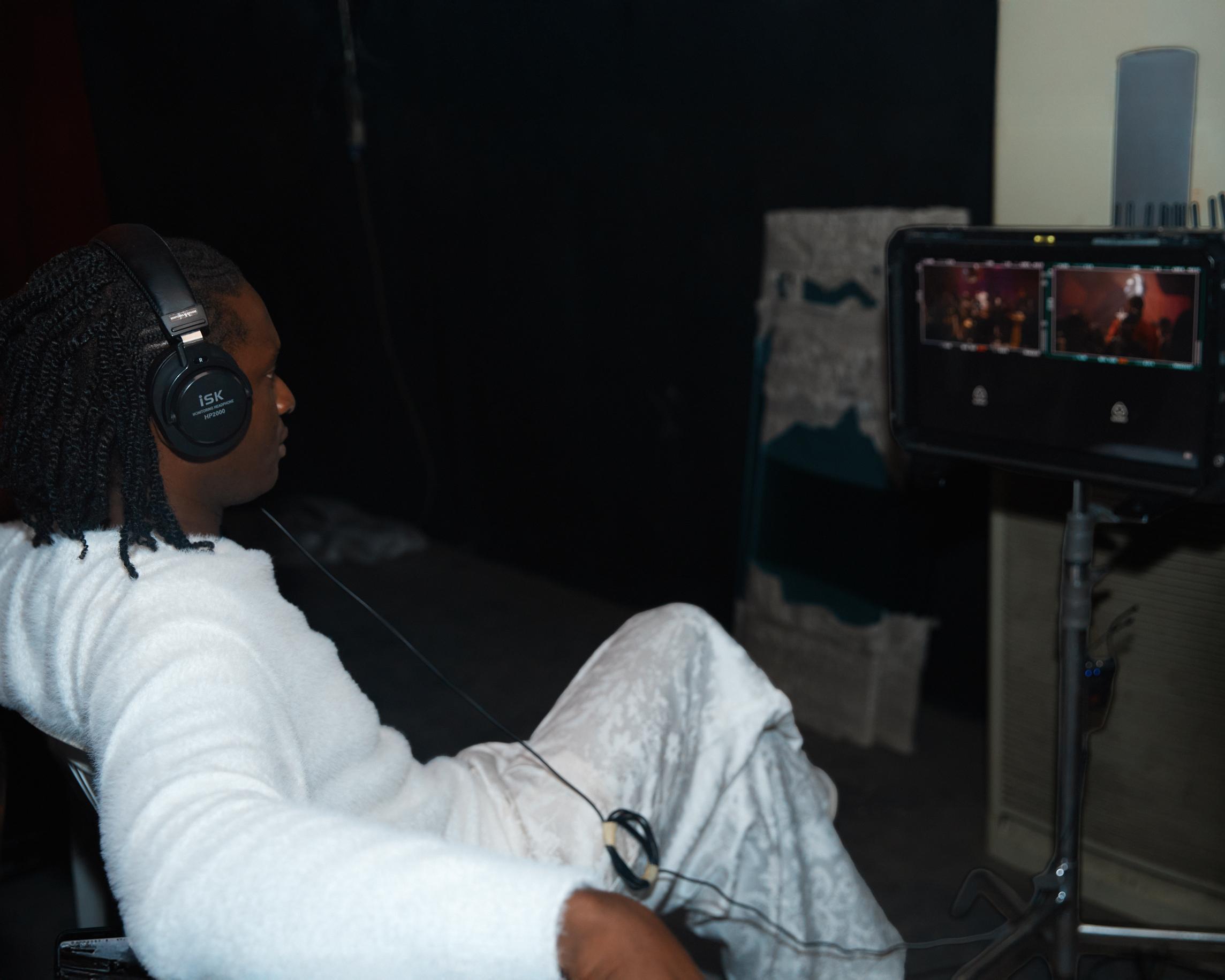
Jack’enneth Opukeme on the set of Aba Blues. Photo courtesy of Jack’enneth Opukeme.
Every filmmaker has a moment where the journey truly begins. Can you take us back to when filmmaking stopped being a general idea and became something you knew you had to pursue?
I majored in directing in school so while writing and eventually acting came later, directing was always the first thing that was always my first love. Also, just being on set for Adire as the creative consultant of the film, as well as an actor in the film, and seeing how the world that I wrote and the characters that I wrote came out alive and how I contributed in my own little way to that, was the major morale or ginger that I needed to chase this thing full-time.
Your films often feel intimate and emotionally honest. What parts of your own life or inner world find their way into your stories, even unintentionally?
I have guiding philosophies rooted in my own upbringing. Growing up in a small town, I noticed how the media often portrayed those places as backwards or unsophisticated. But that wasn’t my truth. I want to elevate middle-class, everyday Nigerians, capturing them as elegant, intelligent, and beautiful. That’s a core part of every story I tell.
Casting can make or break a story. When you’re choosing actors, what are you really looking for beyond talent? Is it emotional truth, chemistry, vulnerability? What tells you, “this is the person”?
I think beyond just talent, I’m really looking for emotional truth. I need to see a spark, a vulnerability, that makes me believe them. Chemistry between actors is also key; it must feel like these characters truly know each other, and when I see that, I just know it’s that person.

Jack’enneth Opukeme
Nollywood is evolving quickly on different scales, commercially, creatively, globally. As a filmmaker working within it today, what worries you about the industry at the moment, if there are any?
One of my biggest concerns is that, despite Nollywood’s rapid growth, funding remains a major hurdle. We can’t have enough conversations about this, because so many ambitious, creative projects are held back by a lack of funds. I believe Nollywood has massive global potential, and we’re proving that with every story we tell. But we need sustained investment, better infrastructure and a true ecosystem that supports both seasoned and emerging filmmakers, so that the work can thrive and be financially viable.
There’s often a tension between telling honest stories and making commercially viable films. Have you ever had to choose between the two, and what guides your decisions?
I believe there doesn’t have to be a trade-off between commercial viability and critical acclaim. I believe that well-told stories can be both. When you look at Hollywood, many of its most iconic films were both commercially successful and artistically rich. I think any filmmaker with a strong, unique voice has a responsibility to push Nollywood in that direction so that mass appeal and quality storytelling go hand in hand.

Jack’enneth Opukeme on the set of Aba Blues. Photo courtesy of Jack’enneth Opukeme.
Who or what has influenced your storytelling the most—whether filmmakers, writers, everyday people, or even places? And how have those influences shaped the way you see stories?
A lot of things have influenced my storytelling: everyday people, their situations, and their stories. But at the heart of it, I’m deeply inspired by Black filmmakers, Nigerian filmmakers and how they’ve captured Black brilliance. Directors like Barry Jenkins, Ryan Coogler, Andrew Dosunmu, and here in Nigeria, Jadesola Osiberu, along with early Nigerian classics by Kunle Afolayan, Izu Ojukwu, Tunde Kelani, and Mahmood Balogun’s ‘Tango with Me, and Chinenye Ayaene’s Ije, showed us as intellectual, nuanced, and beautiful. All of that has shaped the way I see and create stories.

Jack’enneth Opukeme on the set of Aba Blues. Photo courtesy of Jack’enneth Opukeme.
What do you hope people take away from Aba Blues? It’s a film that explores a different dynamic of love. Why does a story of this kind deserve to be told?
I hope that with Aba Blues, people come away with a deeper understanding of love. It’s complicated, it’s universal, but never black and white. Often, we’re told to move on, but we’re not taught how. And I think that’s the question this film leaves us with: how do we heal? How do we protect our hearts from repeating old mistakes? In hindsight, love is a mirror; it reflects all those moments we keep returning to, where we haven’t done the inner work to fully move forward. Aba Blues is about showing us as complex individuals capable of love, betrayal, hurt, and ultimately, it’s about seeing ourselves in all our complexity, moving beyond simple good and bad.
Thank you for your thoughtful responses, Jack’enneth
Thank you for having me.
_
Many thanks to Jack’enneth Opukeme for having this conversation with us and answering all our questions – and swiftly too, we must add.
Do you love this content, have any feedback for us or want to be a BellaNaija Features contributor? We’d love to read from you. Shoot us an email: features@bellanaija.com.
The post “Beyond Talent, I’m Looking for Emotional Truth”: Jack’enneth Opukeme on What Informs His Filmmaking Process in Today’s “Doing Life With…” appeared first on BellaNaija – Showcasing Africa to the world. Read today!.
One of my biggest concerns is that, despite Nollywood’s rapid growth, funding remains a major hurdle. We can’t have enough conversations about this, because so many ambitious, creative projects are held back by a lack of funds.
The post “Beyond Talent, I’m Looking for Emotional Truth”: Jack’enneth Opukeme on What Informs His Filmmaking Process in Today’s “Doing Life With…” appeared first on BellaNaija – Showcasing Africa to the world. Read today!. Read More