

An estimated 75,000 children (aged 0-14) died from AIDS-related causes in Sub-Saharan Africa in 2024, according to the United Nations Children’s Fund (UNICEF) and the World Health Organisation (WHO) statistics. The figures show that 1.4 million children in the region are infected, representing 86% of all children living with HIV globally.
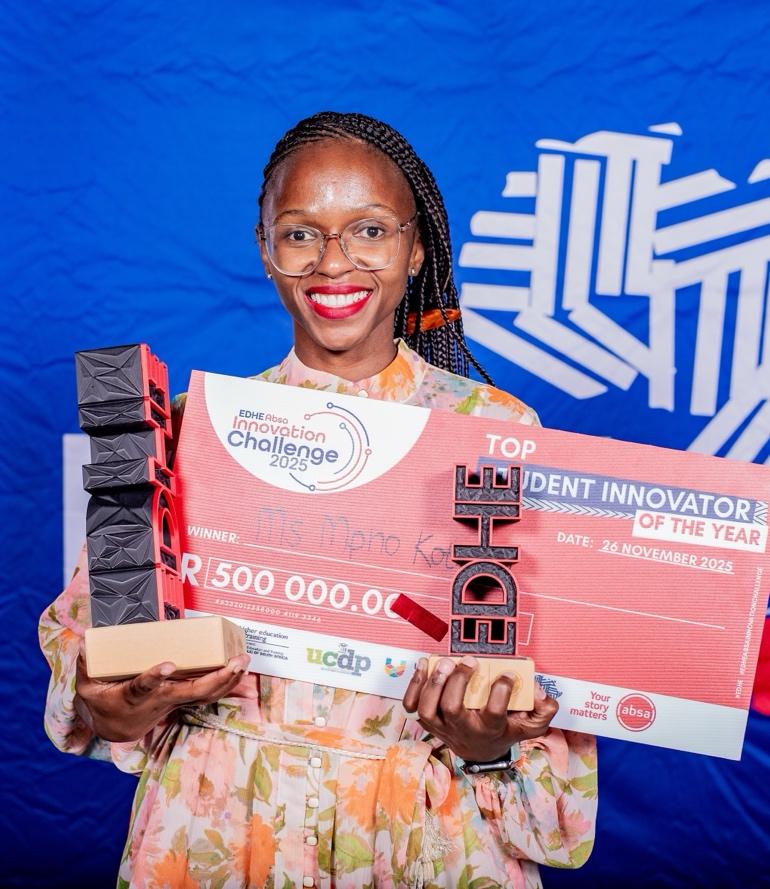
An age-appropriate, child-friendly antiretroviral drug (ARV) for children living with HIV/AIDS may offer a solution to these grim statistics, winning its innovator R500,000 and the EDHE Absa Top Student Innovator of the Year title at the inaugural EDHE Absa Innovation Challenge. This is the largest student entrepreneurship initiative ever launched across South Africa’s 26 public universities, carrying prize money of over R1 million.
This milestone represents not only a personal triumph for 30-year-old Ms Mpho Kotlolo, a full-time PhD Candidate in Pharmaceutical Sciences at the Tshwane University of Technology (TUT) and her PharmaKids team. It signifies a step forward for healthcare innovation in South Africa.
Kotlolo’s work addresses a long-standing gap in paediatric HIV treatment, aiming to improve accessibility, ease of administration and treatment adherence for young patients. She explains: “Children struggle with large and bitter-tasting ARVs. Therefore, current formulations negatively affect adherence, particularly in young children. Crushing tablets to make it easier to swallow can lead to dose inaccuracy, resulting in poor adherence to taking medication, and, by implication, treatment failure and long-term health costs.
“Our innovation primarily targets children living with HIV/AIDS in Sub-Saharan Africa. We have designed a single tablet that has three combinations of HIV drugs (abacavir sulphate, tenofovir and zidovudine) with the addition of a fruity taste-masking agent to make it appealing for children. Our tablet dissolves fast using saliva instead of water, a great benefit for people without access to water.”
Kotlolo conceptualised this ARV project with fellow scientists at TUT and the University of Eastern Finland (UEF), in collaboration with pharmaceutical company, Kiara Health.
“This mission is now about saving the lives of Africa’s children, creating employment and setting the example of how innovation makes a critical and substantial impact on the nation and continent. I have realised that I have to make personal sacrifices and exercise patience to ensure that the product successfully reaches the marketplace and its target audience.”
The R500 000 prize money will be used to unlock product distribution and ensure completion of all critical manufacturing activities, such as quality tests, stability and clinical validation.
Where does Mpho see herself in five years?
“I hope to see myself – with the assistance of my team and financial support from other bodies – operating a manufacturing plant of HIV orodispersible tablets for children and distributing them to the market. This could significantly improve access to essential medications for vulnerable populations, ensuring that children receive the treatment they need in a form that is easy to consume. By collaborating with healthcare providers and community organisations, we can further enhance awareness and facilitate distribution to those who need it most. Currently, 44% of children in Sub-Saharan Africa are not receiving ARTs.”
Kotlolo believes that competitions such as the EDHE Absa Innovation Challenge are critical for unlocking employment opportunities for young people.
EDHE – a programme that aims to develop the entrepreneurial capacity of university students, academics and university leaders – is a collaboration between Universities South Africa (USAf) and the Department of Higher Education and Training (DHET). It helps students become more economically active by providing support, running competitions such as the EDHE Absa Innovation Challenge and EDHE Entrepreneurship Intervarsity, while offering programmes and initiatives to foster entrepreneurial skills.
In closing, Kotlolo says: “Working in a team is important as collaboration fosters creativity and innovation and allows individuals to leverage each other’s strengths. By supporting one another, teams can overcome challenges and achieve their goals more effectively. As young researchers, we have to turn the impossible into possibilities.
“I am living proof of the African proverb ‘if you want to go fast, go alone; however, if you want to go far, go together’.”
Janine Greenleaf Walker is a contract writer for Universities South Africa.
The post South African Innovator of the Year is set to save the lives of HIV-infected children appeared first on The Home Of Great South African News.
An estimated 75,000 children (aged 0-14) died from AIDS-related causes in Sub-Saharan Africa in 2024, according to the United Nations Children’s Fund (UNICEF) and the World Health Organisation (WHO) statistics. The figures show that 1.4 million children in the region are infected, representing 86% of all children living with HIV globally. An age-appropriate, child-friendly antiretroviral
The post South African Innovator of the Year is set to save the lives of HIV-infected children appeared first on The Home Of Great South African News. Read More