


Imagine a developer at a growing South African logistics company who uses an artificial intelligence (AI) tool to summarise customer data. The summary is polished and confident, but wrong. Nobody questions it, and a pricing decision follows. The code worked perfectly; the judgement around it did not.
Scenarios like this explain why the meaning of a ‘skilled’ IT professional is changing. Knowing how to build software, configure infrastructure or deploy a system remains essential, but it is no longer enough on its own. As AI becomes part of everyday tools and processes, employers need people who can also interrogate the data behind a result, recognise when an output cannot be trusted, and explain what it means for the business.
South African employers are already responding. According to CompTIA’s latest Workforce & Learning Trends report, 95% of local businesses say digital fluency is becoming more important, a higher share than in any other region the study covered.
This article explains the difference between technical proficiency and technological literacy, why both now matter in IT hiring, and what South African businesses, including SMEs without a dedicated HR team, can do to hire for both.
Digital Fluency Is Now Essential
South African employers value digital fluency much higher than their global peers. The ability to use digital tools, data and emerging technologies with confidence is fast becoming a baseline expectation, and not only in technology roles.
What Is Digital Fluency?
Digital fluency means you understand how technology works behind the scenes. You can choose the right tool for a job, adapt when software changes, and build brand-new solutions. Think of it like being fluent in a language: you can converse, argue, and improvise smoothly in real time.
The ‘art’ of digital is not just changing systems; it’s also about knowing the language. Every function in various departments interacts with digital systems, whether through data dashboards, artificial intelligence (AI)-powered automation, or cybersecurity protocols.
South African employers are placing a higher value on digital fluency than their counterparts abroad. Some 95% of South African businesses said this skill set, the ability to confidently use digital tools, data and emerging technologies, was becoming more important, a higher figure than in the US (85%), the UK (83%) or Canada (68%).
The pressure is most visible in technology teams. Seven in every 10 employers expect to hire more technology staff to support growth over the next year, yet 37% say their workforce is at 80% of the skills level they need, or below. Employers also know where the gap is widest. AI tops the list of digital fluency priorities, followed by data analytics and cyber security.
But knowing that digital fluency matters is only the first step. The harder question for employers is what it looks like in practice and how it differs from technical skill.
Proficiency vs Literacy in IT
The terms ‘technical proficiency’ and ‘technological literacy’ are often used as if they mean the same thing. They do not, and the gap between them is where many hiring decisions go wrong.
Neil Lund, Managing Director at Paracon by Adcorp, draws the line clearly: “The ability to code, develop systems, or configure infrastructure establishes proficiency. Literacy determines how effectively professionals can interrogate the data informing their work, detect a hallucination, evaluate an output, and understand significance within a particular context.”
Put simply, proficiency is knowing how to build it, and literacy is knowing whether it can be trusted.
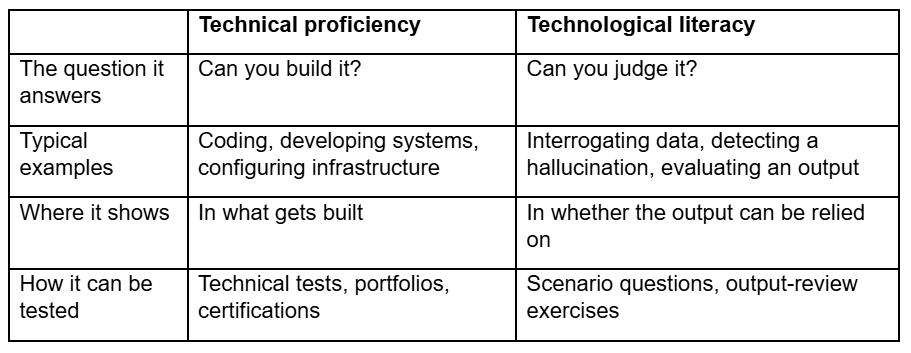
A hiring candidate can be strong in one and weak in the other. A brilliant programmer may accept an AI-generated result without question, while a capable analyst may struggle to build the system that produces it.
Skills Employers Want Most
The shift towards broader capabilities is not just a local trend. Global research points the same way, with employers asking for thinking skills alongside technical ability and not in place of it.
The World Economic Forum’s Future of Jobs Report 2025 ranks analytical thinking as the most sought-after core skill among employers, along with resilience, flexibility and agility, and leadership and social influence. The World Bank has also highlighted demand for transferable capabilities such as communication and problem-solving.
None of this weakens the case for technical skill. As Lund puts it: “These are not alternatives to technical proficiency. They are the literacy that shapes proficiency into practical, implementable processes.”
What SMEs Should Do Next
Small to medium-sized enterprises (SMEs) rarely have a dedicated HR team or an AI specialist, yet they face the same hiring pressures as larger firms. Lund names the core challenge: “For employers (SMEs), the challenge often lies in defining what these capabilities mean within a particular role and then finding credible ways to assess them.”
The solution is having a specialist IT recruiter who can contribute beyond matching job specifications to resumes. An experienced recruiter understands how technical and transferable capabilities intersect across roles, and can help employers identify proficiency and literacy requisites when defining roles. This then streamlines the process of finding and assessing suitable candidates.
Hiring for Literacy, Not Just Code
As AI becomes part of everyday technology, the most valuable IT professionals will be those who can build and also question. Employers who find them will define literacy clearly for each role and assess it fairly.
Lund concludes by saying: “The value of working with specialist recruiters is less about finding people who can code and more about finding the right combination of technical and transferable capabilities.”
Imagine a developer at a growing South African logistics company who uses an artificial intelligence (AI) tool to summarise customer data. The summary is polished… Read More