
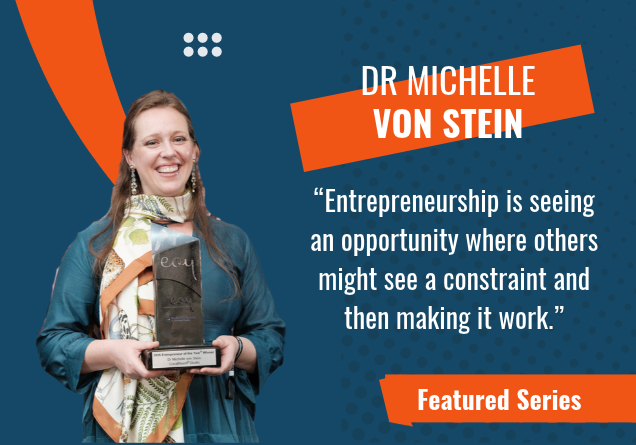
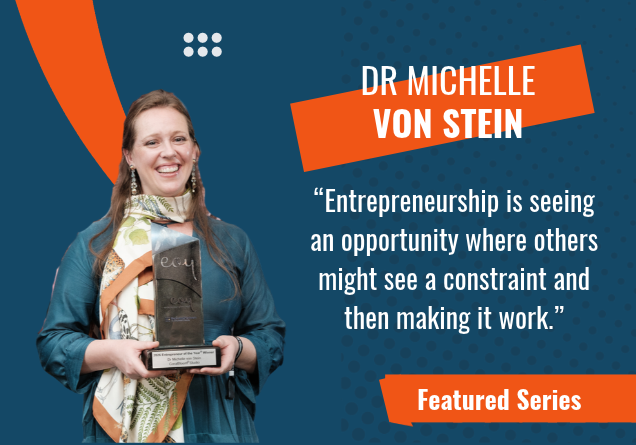
Entrepreneurs all seem to have one thing in common: it finds them, even in their youth. This is true even for Dr Michelle Von Stein, whose Stellenbosch studio, CoralBloom, turns her family’s hand-painted botanical and wildlife artworks into homeware, tableware and accessories.
“In many ways, my entrepreneurial journey began long before I knew what entrepreneurship was,” Von Stein says. “The first product I ever sold was a handmade seashell mobile. My sister, who was six at the time, and I, aged ten, made four mobiles using treasures we had collected while beachcombing and sold them at a local holiday market. To my amazement, we sold all four and received three additional orders! I was fascinated by the idea that you could take something from nature, transform it through creativity, and create something people were willing to pay for.”
She continues to say that curiosity followed her into primary school. “In grades 6 and 7, a friend and I made handmade envelopes from beautiful magazine pages featuring nature and interior design. I still remember her father sitting us down to explain production costs, including the cost of glue and the time it took to make each envelope. He taught us to understand our costs and calculate our profit per unit. Looking back, those were some of my earliest lessons in business.”
Later, in 2010, while studying for my BSc in Biodiversity and Ecology, Von Stein started making and selling hand-embroidered cushions and aprons to shop owners in Stellenbosch to fund her scuba diving hobby. “One day, a shop owner who had commissioned uniform aprons for her café noticed a handmade necklace I was wearing. She immediately wanted it for her shop and asked whether I could supply fifty-five of them.
“I said yes before I had any idea how I was going to make fifty-five identical necklaces!”
With a lot of help from her father and their neighbour, a chemistry professor, they experimented until they created the blue patina that was needed and fulfilled the order. “The shop owner was delighted, and I went on to expand the jewellery range to include earrings and brooches.
“Over the years, I continued experimenting with different materials and products, from beaded and leather jewellery to stationery made from upcycled vintage maps, music sheets and old science encyclopaedias. The products changed, but the underlying idea remained the same: to see potential in something others might overlook, apply creativity and resourcefulness, and turn it into something commercially valuable.
“Entrepreneurship, for me, has always been about seeing an opportunity where others might see a constraint and then finding a way to make it work,” says Von Stein.
Blending Nature, Art and Entrepreneurship
Nature and creativity have always been closely connected to Von Stein’s life. “My parents fostered a deep love of nature and the arts in both my sister, Megan, and me. I pursued that scientific interest academically, eventually completing a PhD in Botany and Microbiology in 2019.”
Moving from academic research into creative entrepreneurship at the age of 28 was an unconventional career change, but she found that her scientific training was an asset. “Science taught me to observe carefully, investigate problems, test ideas and keep refining a solution. These are all skills that translate surprisingly well into building a business.”
Von Stein was running CoralBloom as a side hustle during her undergraduate studies, but after completing her Ph.D., she was considering her next career move. Giving CoralBloom an opportunity to grow was a serious consideration too.
“I remembered a beautiful book of wrapping paper printed with vintage natural history illustrations that I had bought while attending an international conference in Berlin. My partner, Xavier, suggested that I import more of the paper and use it for my handmade stationery collection.
“I invested my savings, with Xavier helping me fund half the cost of importing a box of exquisite paper from the Netherlands. I transformed every sheet into handmade envelopes and notebook covers, selling them to florists, independent boutiques and eventually seven SPAR outlets in the Western Cape. When the paper ran out, I faced a decision: find another supplier or explore whether we could create our own designs.”
That was when Von Stein recognised the potential in the beautiful watercolour artworks created by her mother, Ann, and sister, Megan. “Instead of relying on imported designs, we could develop original South African artwork and build our own distinctive collections around it.
“We began by combining botanical and natural history illustrations of individual plants and animals into carefully composed designs for cards and notebooks. Once we had worked out how to translate the artwork into printed stationery, we started experimenting with textiles,” she recalls.
That was the beginning of the CoralBloom we know today: a design-led brand that transforms original, hand-painted botanical and natural history artwork into functional products for homes, retailers and destinations.
“For me, the opportunity was not simply to put beautiful art onto products. It was to build a commercially viable brand around original intellectual property, one that could offer distinctive designs, tell meaningful stories about South Africa and create products with lasting appeal,” Von Stein highlights. “What started as a small stationery business gradually developed into a broader lifestyle offering. The real shift was moving from making individual products to building a brand, a distinctive design identity and a business model that could grow.”
Producing Art You Can Live In
Today, CoralBloom is a small creative venture into a wholesale design business supplying destination retailers, luxury lodges, hospitality brands, wine estates, conservation organisations and premium retailers in South Africa and abroad. Much of the company’s growth has been driven by referrals and repeat business, reflecting strong customer loyalty and a reputation for quality craftsmanship.
Yet, nature and the impact consumerism can have on the environment remain at the centre of the business. Von Stein explains that nature is both our greatest creative inspiration and an important reminder of why responsible production matters. “We aim to incorporate slow and circular design principles throughout our process, from the way we develop a design to how we print, manufacture and use our materials.
“Where possible, particularly with bespoke and custom collections, we print and manufacture on demand. This means producing what is needed rather than manufacturing large quantities speculatively, helping us reduce the risk of overproduction and unnecessary stock.” She adds that digital textile-print layouts are carefully designed to maximise fabric yield and minimise waste. “Our textiles are printed locally using non-toxic, water-based pigments, and we work with local printing partners who use energy-conscious production technology.”
Furthermore, fabric offcuts are treated as a resource rather than waste. Larger pieces can be repurposed into trims, such as apron straps, while other pieces are kept for potential patchwork projects. The smallest scraps are directed towards local community-led fabric recycling and upcycling initiatives where suitable options are available.
“Our approach also extends beyond the main fabric. We work with local suppliers and makers for components such as woven care labels, handmade tassels and swing tags. By developing products and sourcing components locally, we help support South African skills, businesses and craftsmanship throughout the value chain.
“Our decentralised manufacturing model also allows us to work with independent seamstresses and small manufacturing businesses rather than relying on a single large production facility.
Von Stein emphasises that sustainability is not simply a marketing message or a single material choice: it is about making thoughtful decisions at every stage of the process and taking responsibility for design and production.
“We want our products to celebrate the beauty of nature while reflecting a way of working that respects resources, values craftsmanship and supports the people who make them.”
Climbing to Entrepreneur of the Year
The Coral Bloom® Studio founder took the overall title at the 38th annual Business Partners Limited Entrepreneur of the Year® Awards. Selected from 556 entrants and 15 finalists across multiple categories. The business employs seven people permanently and a further 24 on a temporary basis, with women accounting for 97% of its workforce.
Beyond commercial operations, the studio contributes to a range of social and conservation initiatives. It supplies leopard-themed pieces for Cape Leopard Trust fundraising auctions and works with the Handwork Hub, a social enterprise that trains women in sewing and helps them earn an income. Its fabric offcuts are repurposed into pet beds, which it donates to animal welfare organisations, extending the use of materials that would otherwise go to waste.
This combination of commercial growth, job creation, supplier development and community impact distinguished Coral Bloom Studio among this year’s finalists and contributed to Von Stein’s selection as South Africa’s 2026 Entrepreneur of the Year®.
These elements that contributed to being named Entrepreneur of the Year® are deeply interconnected, and much of their progress has come through the significant growth CoralBloom has experienced over the past three years. “One of our major turning points was securing Tourvest, a leading destination retail group, as a client. Until then, we had largely supplied smaller boutiques and galleries on a consignment basis. Working with a major corporate client introduced a different scale of opportunity, with regular orders and a collection that grew to more than 450 unique SKUs.”
That growth was exciting, but it also presented a significant operational challenge. “We needed to develop a reliable local supply chain capable of producing complex products to consistent quality standards and within relatively short turnaround times.
“As a small business operating from home, we did not have the capital or premises to establish a conventional manufacturing facility. We had to find another way. With guidance from my business mentor, a great deal of hard work and plenty of trial and error, we developed a decentralised manufacturing model.”
In retrospect, what initially seemed like a limitation became one of their greatest strengths.
“Today, we create our original artwork and product designs in-house, then work with three trusted textile-printing partners. Once printed, the fabrics return to our studio, where we cut the pieces and prepare sewing parcels. These are delivered or couriered to our network of 24 home-based seamstresses and six small local CMT (cut, make and trim) businesses.
“Each maker or manufacturing partner specialises in particular products, allowing us to build expertise, maintain consistent standards and distribute production across our network. Once the items are completed, they return to our studio for quality control, labelling, packing and delivery to our clients.
This model has allowed CoralBloom to grow commercial capacity without needing to own a large factory. It also means that growth creates opportunities throughout a wider local supply chain, supporting printers, manufacturers, skilled artisans and seamstresses.
“Because many of our seamstresses work from home, this model makes it possible for women outside major industrial centres to participate in the manufacturing economy,” Von Stein elaborates.
“For me, supplier development is about more than finding someone who can produce an item. It is about building long-term relationships, sharing knowledge, developing skills and creating a network in which everyone can grow alongside the business.
“Our journey has taught me that commercial growth and social impact do not have to compete with one another. When a business develops the right systems and partnerships, growth can strengthen both its financial sustainability and the opportunities it creates for others.”
Entering Business Partners Limited Entrepreneur of the Year® Awards
Von Stein’s business mentor through the Orange Corners Innovation Fund encouraged her to apply to Business Partners Limited Entrepreneur of the Year® Awards. “As entrepreneurs, we spend so much time working in our businesses — solving problems, meeting deadlines, managing cash flow and finding ways to keep moving forward — that we do not always pause to recognise how far we have come,” she adds. “Applying for the award allowed me to reflect on CoralBloom’s journey, the challenges we have overcome and the business we have built. It also encouraged me to look beyond the products we create and consider the broader impact of our work: the local supply chain we have developed, the opportunities we help create for women, and the systems we have put in place to support growth.”
Winning the title was incredibly meaningful to her because it recognised not only the creative side of the business, but also the entrepreneurial thinking, persistence and problem-solving required to turn an idea into a growing enterprise.
“We hope this recognition will help shine a brighter spotlight on CoralBloom Studio and introduce our work to new clients, partners and opportunities, both in South Africa and internationally.
“As a small, design-led business, visibility and credibility can make a meaningful difference. The award gives us an opportunity to share our story with a wider audience and demonstrate that a South African creative business can combine original design, commercial ambition, responsible production and meaningful local impact,” Von Stein shares.
Their next chapter is about building on the foundations they have established: strengthening existing client relationships, reaching new retail and hospitality partners and developing a more diversified customer base for sustainable growth.
“We also want to continue investing in our people and our decentralised manufacturing network. As the business grows, we want that growth to translate into more opportunities for our artists, printers, seamstresses and manufacturing partners, while ensuring that quality and responsible production remain central to the way we work.
“Ultimately, the award is both an affirmation of what we have achieved and an encouragement to keep going. We have learnt a great deal by starting small, making the most of limited resources and finding creative solutions to difficult problems. Now, we want to use those lessons to build an even stronger and more resilient business.”
Von Stein says that success is not simply about growing CoralBloom into a bigger brand. “It is about building a business that can grow sustainably, create opportunities for others and share the beauty of Africa with the world, one thoughtfully designed product at a time!” she concludes.
Entrepreneurs all seem to have one thing in common: it finds them, even in their youth. This is true even for Dr Michelle Von Stein,… Read More