
SA Rugby general manager for referees Mzwamadoda ‘Banks’ Yantolo chats to SIMON BORCHARDT about talent identification, referee development and the challenges of producing world-class match officials.
You grew up playing rugby before becoming a referee. What was your playing background and how did you take up the whistle?
Growing up in the small Karoo town of Somerset East, I was immersed in a community where rugby was the dominant sport. Rugby later became my focus at Cape Teachers Training College.
As a teacher, I began officiating interschool matches across several age groups because referees were often unavailable on match days. This sparked my passion for refereeing, and neighbouring schools and community clubs frequently asked me to officiate their important matches.
I officially joined the Border Rugby Referees Association in 2000, but a niggling knee injury, having undergone arthroscopy twice, forced me to stop refereeing in 2003.
How did you make the transition from refereeing to assessing and developing other referees?
Once a teacher, always a teacher. The role now known as referee performance reviewer was then called assessor.
A strong knowledge of the laws – ideally 90-100% – and a sound understanding of the game are essential. As a referee, I learned to conduct thorough and brutally honest self-reviews, which made the transition to assessing a natural one.
The role also requires strong people-management skills and an understanding of individuals. Identifying talent and potential involves assessing not only referees’ on-field performances but also their conduct and ambassadorial qualities off the field.
You combined refereeing roles with working as a school principal. How did you balance the two before joining SA Rugby full-time?
Fortunately, rugby is played mainly on weekends and during school holidays. The World Rugby Sevens Series tournament in South Africa was held in December, while the 2013 World Cup Sevens in Moscow took place during the June school holidays.
Currie Cup matches were televised, while non-broadcast matches were recorded and uploaded to the SA Rugby platform or put on a hard drive and couriered for review. Skype or Telkom conference calls were then used for feedback.
The national Youth Weeks also take place during the June/July school holidays and have always provided a development pathway for up-and-coming referees. We monitor referees nominated by their societies, provide intensive coaching and assess their performances for possible selection and promotion to the national panel.
How has the job of developing and managing South African referees changed?
South Africa is unique in that rugby is played and officiated by people of all races and across all walks of life. Inclusivity, equity, fairness and transformation are driving forces in serving the game.
The number of competitions is expanding rapidly and the demand for match officials is beyond the capacity of the current referee pool. Our focus is on attracting younger male and female referees, ideally aged 26 or younger, to give them a long development pathway.
Referee abuse remains a major cause of declining numbers, and provincial authorities do not always take sufficiently stringent action against offenders. Parents are understandably reluctant to allow their children to enter an environment they perceive as threatening or hostile.
Refereeing became a standalone SA Rugby department in late 2024. What does your role as general manager for referees encompass?
The Referees Department operates in a unique environment shaped by the changing global rugby calendar. Match officials working abroad can face challenging situations that require immediate guidance, so I must remain accessible and ready to make important decisions at any time.
Within SA Rugby, my role includes building relationships with key stakeholders, developing and implementing strategies to meet transformation targets and strengthening match officiating in community rugby.
Internationally, we need to align with best practice and ensure South African referees meet the standards and expectations of World Rugby, EPCR and the URC, while equipping them with the latest information, techniques and international practices.
SA Rugby introduced separate elite and national referee panels in 2025. How does the pathway work?
The elite panel consists of proven referees officiating in top-tier domestic competitions such as the Currie Cup. National panel referees compete for opportunities at elite level when they arise, such as when elite officials are unavailable because of international duties. They can then be assessed as candidates for promotion.
The system has produced encouraging results. In this year’s Currie Cup, four national panel rookies came close to contention for the playoffs. They are next in line to be introduced to the URC.
What qualities do you look for when identifying a potential elite referee?
After the talent-identification process, referees who meet SA Rugby’s fitness levels and standards are invited to the national Youth Weeks, where national performance reviewers assess them and national referee coaches provide intensive coaching.
We look at social interaction, leadership and ambassadorial qualities, coachability and a learn-and-grow mindset, teamwork, curiosity and initiative. Resilience after a disappointing performance is important, as are honest self-review and a commitment to improvement.
How do you identify promising referees across all 15 provincial referee societies?
We rolled out the referee coaching blueprint across all 15 societies to promote consistent coaching and alignment. Each society nominated four to six coaches for an empowerment and development session, equipping them to mentor emerging referees locally.
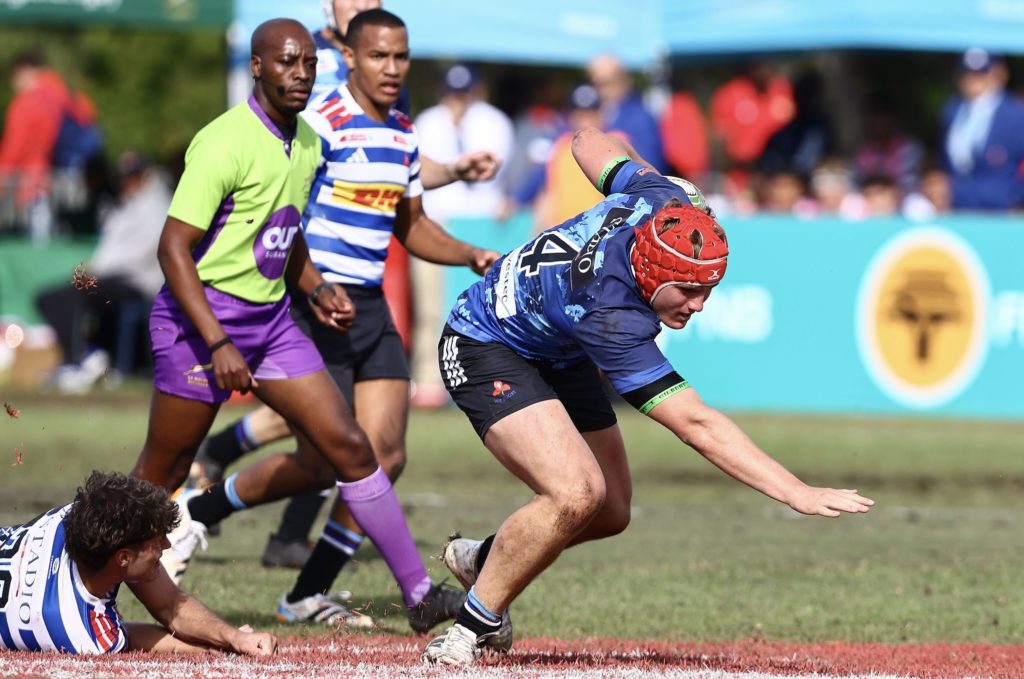
Each society also nominates three referees under 25 for scouting. With most schools matches now streamed nationally, we can assess them remotely, while referees are also observed at season-opening rugby days, Easter tournaments and March school-holiday festivals.
Where a union has limited top-level schools rugby, it can work with neighbouring unions to provide its referees with greater opportunities. Selected referees then receive more game time, intensive local coaching and focused preparation before attending national Youth Weeks.
How valuable is the experience of former Test referees such as Jaco Peyper, Mark Lawrence and Marius Jonker?
Their presence in our panels is invaluable. Aimee Barrett-Theron, Zoë Naudé, Giana Viljoen and TMO Quinton Immelman are excelling in World Rugby women’s competitions. Morné Ferreira and TMO Marius van der Westhuizen are making their mark at World Rugby men’s level, while Christopher Allison, Griffin Colby and Hanru van Rooyen are establishing themselves in the URC and EPCR. AJ Jacobs is also a leading referee on the World Rugby Sevens circuit.
The experience and mentorship of Jaco, Mark and Marius is immeasurable in helping our referees manage the pressures of officiating at international level.
Why are male and female referees now incorporated into the same elite and national panels?
Integrating female referees into what was previously a men-only national panel produced great dividends. It starts at national Youth Weeks, including Grant Khomo and Craven Week, where they are challenged by the pace and intensity of schoolboy rugby.
Female referees are highly competitive and being alongside male referees brings the best out of them. They work hard to prove they belong, which prepares them mentally and physically for World Rugby women’s competitions. We have seen that with the progress of Barrett-Theron, Naudé [below] and Viljoen.

How much more demanding is it to prepare an elite referee today?
The game has evolved immensely. Ball-in-play time has increased, so players are fitter and stronger, while technology has added another layer to decision-making. Social media has also created armchair experts.
Elite referees face social media criticism, scrutiny through technology from coaches and other external pressures. They need to be prepared for those challenges through thorough preparation and exercises that improve decision-making.
How do you help referees deal with criticism and mistakes without losing confidence?
They know the job is demanding. You should not become a professional referee unless you accept that criticism is part of the journey. You have to learn from mistakes and not take things personally. We provide a support structure with multiple layers, including mental, physical and technological tools.
How would you assess the health of South African refereeing at present?
We have gone through a difficult period. Previously, the pathway to international rugby was Currie Cup, Super Rugby and then Test level. When we moved north, it became Currie Cup, URC, EPCR and then international rugby, so another layer was added at a critical transitional stage.
The move to the URC happened in 2021 and Jaco Peyper, one of the world’s top referees, was injured and then retired after the 2023 World Cup. We had to fill that enormous gap while finding our feet in a new competition.
What people may not know is that South Africa has the most referees in the URC. Our most experienced URC referee has only about 24 matches, while the group has officiated around 60 between them. Many other URC referees have more than 50 matches individually, so we are behind in experience.
But we have an exciting and strong group coming through.
Is South Africa attracting and retaining enough referees at school and club level?
Definitely not. Referee abuse plays a major role. The game in South Africa is growing tremendously and a lot is being done, but every time a referee is attacked or abused, we lose referees. Clubs, schools and unions can still do more.
BUILDING THE FUTURE: ‘Data is the new oil’
What would you like the South African refereeing system to look like in five to 10 years?
Our system is geared to produce world-class officials to serve the game at all levels. We are recruiting more expertise at elite level and investing heavily in new technology, while our focus in the community game is on coaching, education and training. That is probably where we can make the biggest difference in the short to medium term.
At international level, we need representation at the selection table, as we had during the Super Rugby era. Our referees can be as good as they can be, but without a seat at the table we will always lag behind countries that are strongly represented.
FREE DIGI MAG: The value of Siya

Photos: Richard Huggard/Grant Pitcher/Gallo Images
The post Behind the whistle: ‘The job is demanding’ appeared first on SA Rugby magazine.
SA Rugby general manager for referees Mzwamadoda ‘Banks’ Yantolo on talent identification, referee development and the challenges of producing world-class match officials.
The post Behind the whistle: ‘The job is demanding’ appeared first on SA Rugby magazine. Read More