Rugby still needs the TMO, but in a reduced role that puts the man with the whistle back in charge, writes SIMON BORCHARDT.
Former South African Test referee André Watson, who blew two World Cup finals, gave a scathing assessment of the TMO’s role over the weekend.
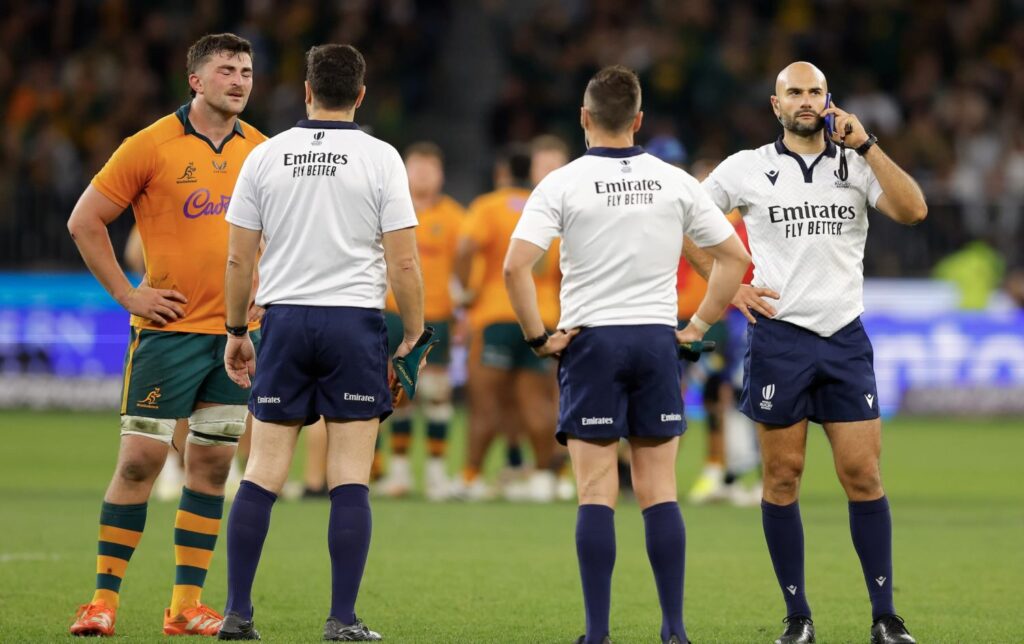
“If I become minister of sport, I will ban the TMO. It has no place in rugby,” Watson told Rapport when asked about the chaotic Test between the Wallabies and Springboks in Perth, during which referee Andrea Piardi was forced to use a cellphone to communicate with the TMO after an equipment failure.
“It undermines the referee’s sharpness, because he relies on the guy up there,” he added. “It was originally introduced to deal with what the human eye cannot see, but what we see these days is that the guy up there in the box is blowing the game.
“I think it’s annoying for the spectators and it’s annoying for the players, even if they just accept it.”
I agree with Watson that the TMO’s ever-increasing role, to the point where he is almost running the show from behind a screen, has had a negative impact on on-field officiating, as referees know they have an all-seeing ‘back-up’.
I also agree that TMO interventions are often annoying, especially after a try has been scored and players’ and fans’ celebrations are put on hold while the TMO watches replay after replay.
However, banning the TMO completely, as Watson suggests, would be throwing the baby out with the bathwater – in other words, getting rid of something valuable while trying to eliminate something unwanted.
The solution, then, is not to get rid of the TMO, but to raise the threshold for when he becomes involved.
For me, the TMO still has a valuable role to play when it comes to picking up clear and obvious mistakes missed by the on-field officials, whether it’s a blatant forward pass or knock-on in the build-up to a try, or checking the grounding of the ball over the tryline.
In professional sport, where winning or losing can decide players’ and coaches’ fates, we can’t have a situation where everyone watching on TV can see an obvious mistake but the officials can’t be alerted to it.
However, we also can’t have a situation where the game is stopped for several minutes after a try has been scored because the TMO has spotted a 50-50 ruck infringement and feels the need to insert himself into the game. For me, if the referee and assistant referee closest to the ruck were happy with what they saw, then it’s play on and the decision to award the try stands.
The TMO’s role in foul play also needs to be removed. How often is the game stopped because of suspected head-on-head contact in a rugby collision that, not so long ago, was accepted as part of the game?
Instead of stopping the match and dishing out cards for unintentional foul play like this, let the citing commissioner review the incident afterwards and, where warranted, hand out a ban.
That would still punish the offending player without potentially having such a significant impact on the game itself. In Perth, two of the Wallabies’ four late yellow cards were for head contact, contributing to a 15-on-11 contest.
Blatantly high and dangerous tackles can still be dealt with by the on-field officials, as they were before technology became such a prominent part of the game.
MALLETT: TMO a blight on rugby
Reducing the TMO’s role in this manner would once again make the man with the whistle the primary decision-maker, while still providing him with the support he needs and the peace of mind that any genuine howlers will not be missed.
Photo: James Worsfold/Getty Images
The post Don’t ban the TMO appeared first on SA Rugby magazine.
Rugby still needs the TMO, but in a reduced role that puts the man with the whistle back in charge, writes SIMON BORCHARDT.
The post Don’t ban the TMO appeared first on SA Rugby magazine. Read More