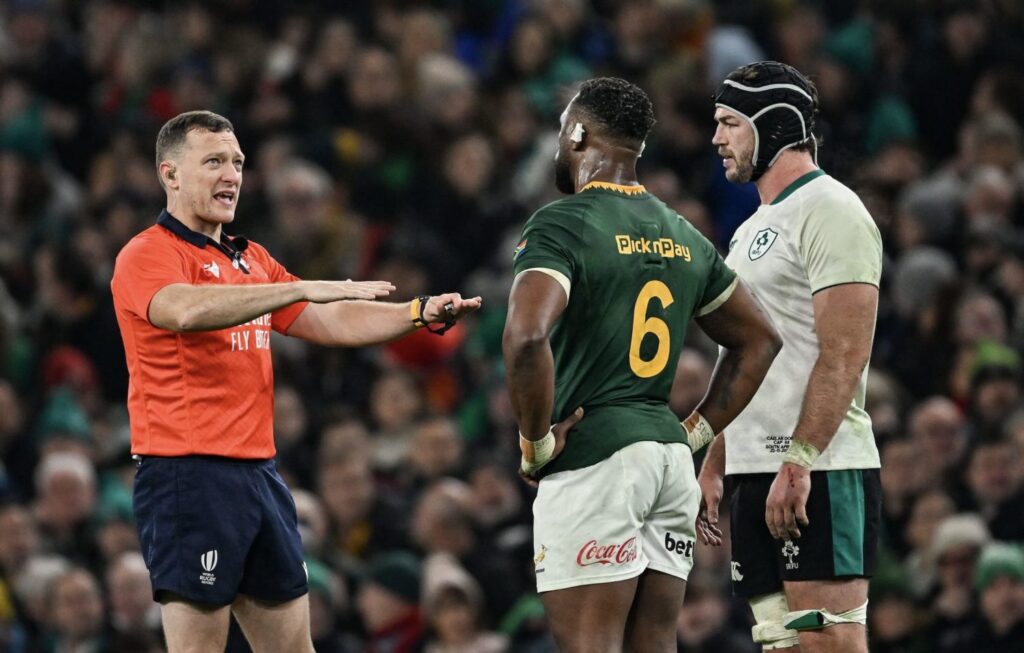
Springbok coach Rassie Erasmus says World Rugby’s new match-official communication protocols are forcing teams to voice their concerns in the media. SIMON BORCHARDT reports.
Under the protocols, head coaches can only meet with a referee before a Test if both coaches accept the invitation and attend the meeting together. Post-match, coaches are limited to submitting six video clips for clarification on a central system, with those submissions visible to other international coaches and match officials.
Erasmus questioned the system last month, saying it had created a communication gap between coaches and referees.
That issue has again come to the fore during the Rugby’s Greatest Rivalry tour, with the All Blacks using the media to push the narrative that South African teams – including the Springboks – look to slow the game down in an attempt to negate New Zealand’s high-tempo approach.
ALSO: Why Rassie’s keeping All Blacks waiting
Speaking ahead of Saturday’s first Test at Ellis Park, which will be refereed by Englishman Matthew Carley, Erasmus said he understood why concerns were now increasingly being aired publicly rather than directly with match officials.
“I think there’s definitely frustration from the coaches that you can’t have meetings with the referee if both teams don’t agree,” he said. “It’s now at a stage where you almost accept both teams’ coaches aren’t always going to agree to a pre-match meeting.
“I myself this week said, ‘No, no, we don’t need one,’ because it doesn’t help now, after they’ve played four games, and now we want to sort out things in three training sessions.
“We had to look at what they put on AMS [Athlete Management System] – that’s a central system – and then sort of learn from what the answers are from World Rugby.
“I don’t think it’s a tactic. I think it’s an obvious thing: if you want to get something out, you have to get it out here [in a press conference] because you can’t really talk to the referee sometimes.”
PLUS: Siya, Ox on the bubble for Boks
Erasmus said the restrictions also make it difficult for coaches to alert referees to specific tactical aspects of their game plan that could affect how an incident is interpreted.
“There are small things which, in normal referee meetings, you alert them to: ‘Listen, we might do a midfield maul, just be aware of that, know the law around that.’
“Now you can’t, because you have to have the meeting with the other coach. You can’t say, ‘Listen, we may be doing a front peel in the lineout, maybe don’t stand there when we do the front peel because you might not see if it’s obstruction or not.’
“So I think teeing up the referees with things you want to do is very difficult, and I totally understand why the All Blacks voice some of their concerns.
“If they genuinely believe we slow down the game, they can’t say it in a meeting with us being present and we’re arguing with them, ‘We’re not slowing it down.’
“So it’s a very natural thing to do it in the media now because of the protocols.”
MORE: Peyper shuts down ‘slow down’ talk
Erasmus remains unconvinced by the reasoning behind them.
“I feel – and I know a lot of international coaches feel that way – it’s very clear what you must do and what you can’t do. It’s in place and we understand that it’s there. I don’t understand why it’s like that.
“But, yes, I think there’s definitely now a gap between coaches, scrum coaches and referees on small little tactical things, and then you voice your opinion in the media. That’s the only option.”
ALSO: Pick your Bok team to face All Blacks
Photo: Ramsey Cardy/Sportsfile via Getty Images
The post Rassie: Media used to get message to refs appeared first on SA Rugby magazine.
Springbok coach Rassie Erasmus says World Rugby’s new match-official communication protocols are forcing teams to voice their concerns in the media.
The post Rassie: Media used to get message to refs appeared first on SA Rugby magazine. Read More